
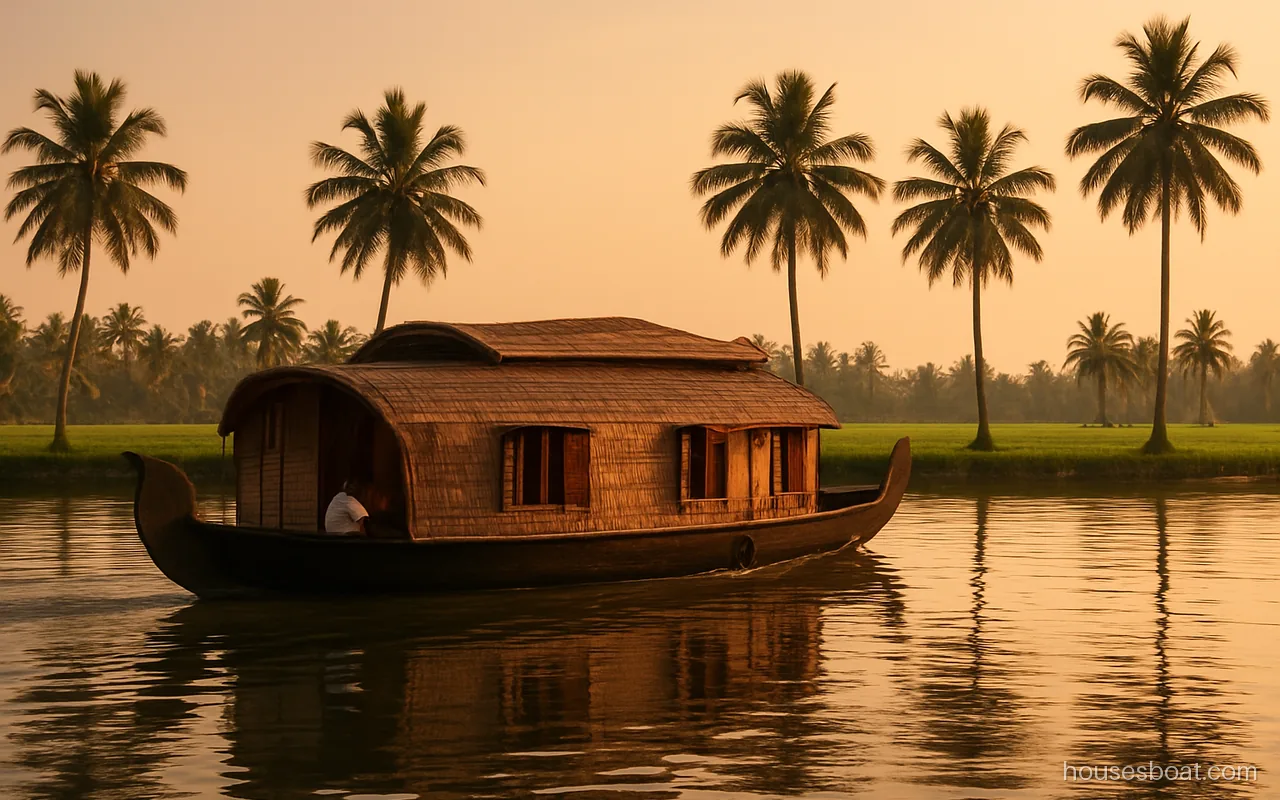
A kettuvallam houseboat is a modern guest boat built on the pattern of the kettuvallam, the old rice and cargo barge of the Kerala backwaters, whose name means roughly a boat tied together, because its wooden planks were bound with coir cord, not nails. Knowing how the original was made helps you tell a traditional Kerala houseboat from a newer boat that only borrows the look.
Quick facts
Name
Kettu (tied) and vallam (boat): a boat tied with rope.Hull
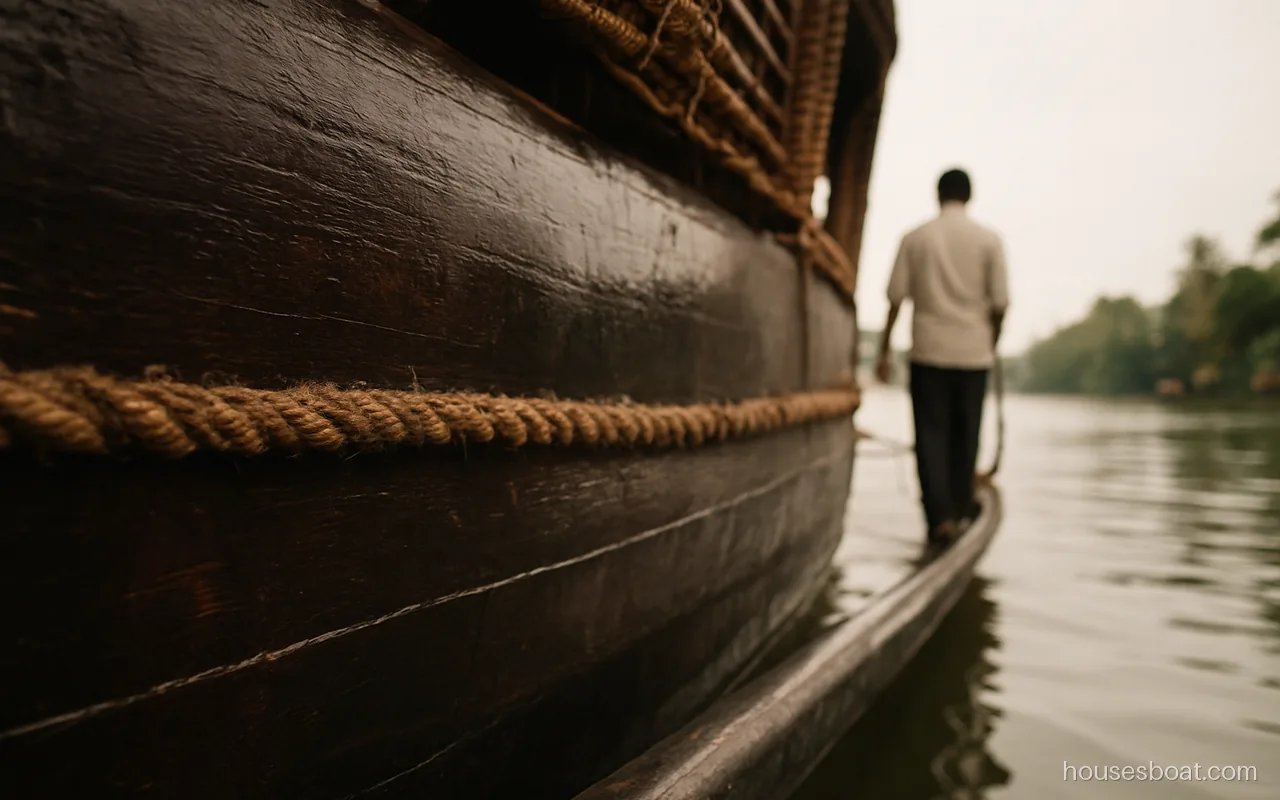
Anjili (wild jack) wood planks lashed with coir.Finish
A dark coating of cashew nut shell oil.Roof
Bamboo frame under woven palm or coir mats.First use
Carrying rice and goods across the backwaters.Today
Converted into houseboats with bedrooms and kitchens.
From rice barge to kettuvallam houseboat
Long before tourism, Kuttanad's paddy, coconuts and spices moved by water. Long, broad barges carried the cargo between farms, market towns and the port, poled or rowed by crews who lived on board for days, with a curved shelter at one end for sleeping and cooking. Once lorries and new roads carried the freight, many barges sat idle. Owners realised that the covered barge could carry visitors instead, added bedrooms, a kitchen and toilets, and the houseboat trade was born around Alleppey.
Today almost every boat on the backwaters descends from that design, even if the hull is newer and the roof hides air conditioning.
How the kettuvallam was built
| Part | Traditional material | Why |
|---|---|---|
| Hull planks | Anjili, the wild jack tree | Strong, durable in water, easy to shape |
| Joints | Coir rope stitched through the planks, with coconut fibre packed into the seams | Flexible and repairable; no nails to rust |
| Coating | Boiled cashew nut shell oil | Seals the wood and resists rot and boring creatures |
| Roof | Split bamboo arches covered in palm leaf mats | Light, shady and cool |
| Floor | Wooden boards over the hull ribs | A flat deck for cargo, later for rooms |
Building one was skilled, slow work done by specialist carpenters on the riverbank, and the best boats lasted for generations with regular care.
What changed when barges became houseboats
- Rooms: the cargo hold became bedrooms with attached bathrooms.
- Power: poles and oars gave way to engines, and a generator for lights and AC.
- Front lounge: an open sitting and dining area was added at the bow.
- Kitchen: a proper galley at the stern for the crew's cooking.
- Upper deck: on many boats, a second level with chairs.
Our interior guide walks through the rooms of a modern boat in detail.
Traditional versus modern Kerala houseboats
| Traditional style | Modern style | |
|---|---|---|
| Look | Dark oiled wood, curved woven roof | Glass panels, painted or polished surfaces |
| Lounge | Open sides with bamboo blinds | Often enclosed, sometimes cooled |
| Feel | Airy, close to the water, warmer at midday | Comfortable in heat and rain, more closed in |
| Suits | Those who want the classic backwater mood | Families wanting full day comfort |
For high end glass boats, see the luxury houseboat page.
How to find a traditional Kerala houseboat today
Fully rope stitched hulls are now uncommon; many newer boats use nailed or fastened planks, or other materials, under a traditional looking roof. If the old craft matters to you:
- Ask the operator directly how the hull was built and how old the boat is.
- Request close photos of the hull, not just the bedrooms.
- Look for a woven palm or bamboo roof rather than a fibre or tin sheet roof.
- Choose an open sided lounge with bamboo blinds over a glass enclosed one.
- Whatever the style, confirm the boat is licensed; the classification scheme is explained on the state tourism website.
Seeing kettuvallams being built or repaired
Boatyards around Alleppey and Kuttanad still repair and build houseboats, and from the water you may pass one with a hull up on the bank. Ask your crew; some know a yard where visitors can watch from a polite distance. Do not wander into a working yard without permission.
The bases where these boats operate are compared in our Kerala backwaters hub; if you are new to the idea of a houseboat at all, start with what is a houseboat.
Questions travellers ask
What does kettuvallam mean?
It comes from the Malayalam words kettu, meaning tied, and vallam, meaning boat. The name refers to the way the planks were stitched with coir cord rather than fixed with nails.
What wood is a kettuvallam made of?
Traditionally anjili, the wild jack tree, which is strong and holds up well in water. The planks were then sealed with oil from cashew nut shells.
Are all Kerala houseboats kettuvallams?
They all follow the kettuvallam shape, but many modern boats use different building methods and materials under a traditional looking roof. Ask the operator about the hull if it matters to you.
Is a Kerala traditional houseboat comfortable?
Yes, with some trade offs. The open lounge is airy but warmer at midday, while bedrooms usually still have AC at night and attached bathrooms.
What was the kettuvallam used for before tourism?
It carried rice, coconuts and other goods across the backwaters, with the crew living on board during long trips.